
I’m a big fan of lists. To-do lists mostly, though I also keep lists of books to read and movies to watch. Shopping lists, obviously. The outline for this review is in list form. I sometimes get too wrapped up in work, so I keep a list of things I should be doing for fun, to unwind. Video games normally hover near the top.
That said, I have a more mixed relationship to the in-game lists many modern titles provide. This was clarified for me when I played a lot of Fortnite across 2021 and 2022. When I started, I ignored the quests and to-dos, instead focusing on figuring out what the hell this game even was. I enjoyed that; with its large, open spaces and many approaches to play, Fortnite is a good place to wander. I would log in every day and just experiment. What happens if I climb this mountain? How many of the Daily Bugle’s supports do I need to knock out before the whole thing collapses? Yes, this is a shooting game, but what if I just drive around in this boat?
After a few months, I noticed I was inadvertently checking items off the game’s many lists anyway. I would visit Logjam Lumberyard and Fortnite’s quest list would ding. You were supposed to do that, hero! And yes, you were supposed to access that comms beacon, great work. The next objective is just over the hill, why don’t you check it out since you’re in the area? I started paying attention to the game’s many quests and looked into what they asked of me, which was more educational than I anticipated. I learned the game’s structures had weak points when I was asked to strike ten of them. When the quest list told me to jump in and out of the water, I learned that doing so granted a speed boost. And each time I completed one of these quests, I earned a bit of currency to buy things. Hey, I like buying things. I like being rewarded.
A few months later I was logging in daily, but I was no longer wandering. Some of these quests, these lists, only lasted a day, or a week, or a few months. Everything was on a timer, gone forever at the clock’s expiration. I didn’t realize I stopped doing what I enjoyed and started playing for rewards until I noticed Fortnite felt less like a game and more like a job. So, I stopped doing that. I still played, but I actively ignored the to-do lists, rewards, currencies, and shop. And, just like that, the game was fun again. I was paying attention to what I enjoyed about the game, and adjusting my play accordingly. I still play, though not as much, and mostly with friends. That’s how I enjoy Fortnite most.
Sonic Frontiers is a new kind of Sonic game. It takes Sonic mostly out of the narrower tracks that define his lineage and plops him onto a series of open islands, not dissimilar from Fortnite. And rather than ask Sonic to make it from Point A to Point B, it gives him a slate of objectives. Your friends are in danger! Here’s your to-do list.
The game opens with Sonic searching for the Chaos Emeralds. This time, their signal is emanating from the Starfall Islands, and he’s flying there with Tails and Amy in the team plane. The trip isn’t smooth: the whole plane is snagged by an invisible force above the ocean and then yanked into a hole in space. Sonic tumbles outward into the air, but doesn’t hit the water. Instead, he awakens in an echo of Green Hills, twisted into a new formation and ruptured with glitches and digital imperfections. For all its remixing, this first Cyberspace level is standard 3D Sonic fare, and your initial tutorial for the game. It’s a platforming gauntlet, albeit one mixed with a tutorial.
Upon beating the classic-style level, Sonic is spit onto Kronos Island, the first zone of Frontiers’ “open-zone” game world. It soon becomes apparent that the Starfall Islands and Cyberspace are intertwined: the islands provide broad natural settings for free movement, scattered across which are portals to Cyberspace for the more focused platforming the series has honed in modern Sonic titles. While Sonic can move back and forth between these realities, his friends are trapped somewhere in Cyberspace, and can only communicate through the holograms they project onto each island. This provides the structure for the game: explore the island, gather intel from Sonic’s friends, find the Chaos Emeralds, and transform into Super Sonic to beat the island’s Titan overlord. Following that, the Emeralds scatter onto the next island, which holds another trapped friend and another Titan.
Going into Sonic Frontiers, I had my doubts about how exploration would work in a Sonic game when its title character is known for speed. Isn’t exploration careful and methodical? The islands are filled with ruins, caverns, hills, and cliffs; won’t they just pass by in a blur? Yes, and also no. The game accommodates Sonic’s speed by putting ample space between its points of interest. Standing on sandstone ruins, I see the desert spread out before me, with a series of black steel sculptures in the distance. The desert is plain compared to most Sonic games, its surface curved softly like a giant blanket thrown over a bed, though not yet patted down. But it’s also dotted with opportunities, such as speed boosters, enemies you can defeat or simply pass by, and the Guardians, which are larger machines that function as impromptu bosses. When you run within range of these Guardians, the camera zooms in on them, and their name flashes across the screen. It’s a clear set-up for conflict, but oftentimes you can just keep running. After all, you’ve got somewhere to be.
Like many open-world games, Sonic has a map and a compass to guide him to where he “should” go. And while the game allows for free exploration, there’s always a clear next objective, the to-do at the top of the list. Sometimes that means speaking with an ally projecting from Cyberspace to help Sonic strategize and understand his surroundings. Other times, Sonic is directed to an Emerald Vault, a kind of steel-claw contraption gripping its namesake jewel. And, commonly, these destinations aren’t easily accessible. Maybe Tails’ hologram is on top of a cliff, and you’re at the bottom. Maybe you see the Emerald Vault, and it’s across a channel of water on a smaller landmass jutting out from the waves. My compass is pointing there, but how do I reach it? Looking up, you see a series of grind rails floating in the sky that look like they end where you need to go. But where do they start?
Here’s a typical scenario: Sonic is running across the island, and enters a forest. Near one of the trees is a spring with a red cap, something that’s been present in the series since the first game released in the nineties. This one’s tilted at an angle; Sonic hits the spring and shoots up into the forest canopy, where he hits another that launches him into a different branch, and a different spring. That spring directs Sonic out of the forest’s top and onto a grind rail, which loops and intertwines with another rail. At this point, the player does a quick scan; Sonic’s current track arcs toward the coast, while jumping to the new rail would direct him into a series of steepled, gray ruins. The player has to decide quickly: the rails will soon diverge.
These kinds of paths are woven into each island, representing both a navigational challenge and a shift in gameplay. Hitting one of the many springs, ramps, and launchers on the island’s surface has the surprising effect of changing the gameplay from open-world roaming to something more focused: the camera locks into place, and the platforming controls tighten, as if you were in a Cyberspace level. These sequences of stunt-objects form pathways across the island, lacing linear platform action throughout the island’s open space. They’re a blast to play, but they frequently constrict Sonic to the pre-determined path until its completion: more than once I found myself trying to reach a location via one of these obstacle-chains, only to shoot past it, unable to dismount until I had finished the sequence. Furthermore, the looping, twisting nature of these paths tend to make them inscrutable from the outside. You may know where you need to go, but determining how is often a matter of trial and error. If you have three springs in front of you, one may take you to your destination, but the others will lock you to a track leading elsewhere, leaving you more lost than before.
Navigation isn’t the only hurdle between Sonic and his goal; almost all of his objectives have a resource requirement as well. Opening an Emerald Vault requires Vault Keys. You have to retrieve Vault Keys from Cyberspace, but the Cyberspace portals scattered around the islands require Ancient Gears to open, which you can only get by defeating the islands’ Guardians. Do you want to help one of Sonic’s trapped friends? You’d better have enough of their Memory Tokens; otherwise they can’t talk to you. And that doesn’t even cover the stone Kocos (used for upgrading Sonic), Power and Defense Seeds (also used for upgrading Sonic), Rings (used for Sonic’s health) and Fishing Tokens (Big the Cat needs them, to live!). It’s a lot of accounting to ask of a character that doesn’t have pockets, and a major hurdle between you and completing your objectives. Just figuring out how to reach an objective can be hard. Getting there and not having enough of the required doodads? Infuriating.
Here’s the thing: I like to role-play my games. When Sonic is dropped onto Kronos and told that saving his friends is that way, that’s where I’m going to go. Who wouldn’t? But that’s not a fun way to play the game. It’s like hopping into a race car, peeling out at “go,” but then stopping every few minutes to count your change. Playing to the game’s objectives and lists is a miserable experience.
But Sonic isn’t a car. He doesn’t do tight turns or quick stops. Instead, he’s more like an unruly breeze, tilting rather than turning, flowing instead of rushing. And while I’m a list guy, Sonic isn’t. Throughout his series, he’s been characterized as more flippant and carefree, representing freedom in contrast to Eggman’s control. Paradoxically, he’s both fast and unhurried. Frontiers gave me a list, an urgent to-do, but that goes against what makes this style of game enjoyable. Furthermore, playing in that way is role-playing myself in this world, rather than stepping into Sonic’s shoes.
I had the most fun with Sonic Frontiers when I relaxed, and let myself be drawn into whatever escapade looked most appealing. Yes, Knuckles, I know you’re a hologram frozen in place. But have you seen this ramp, and that twisted rail? Besides, even if I ran right to you, I wouldn’t have enough tokens. And where are those tokens? They’re found on most of the trick-sections, the side stuff, the stuff that’s fun to explore at your own pace. Once I started ignoring the objectives, I found I would arrive at them anyway, after following a winding path of my own making. And I seldom arrived at that destination without everything I needed.
And without the to-dos and the objective list? There’s so much here to love. Most Cyberspace levels are highly polished Sonic, thrilling and a joy to re-run for better times. Each one takes the scenery of iconic Sonic levels such as Chemical Plant or Radical Highway and warps them into something new and thrilling. These images of the past are mixed with a modern electronica soundtrack that pushes everything from dance aggression to glitch rock, creating variety even when you’re on your fifth Green Hills-styled level of the game. Yes, this series would benefit from inventing some new iconography, but this is the best some of these locales have ever looked or played.
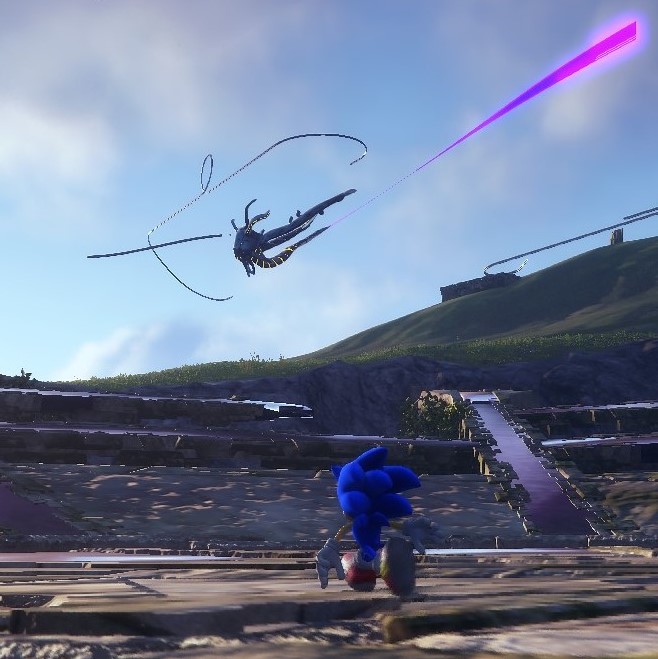
Outside of Cyberspace, the islands’ open surfaces are littered with secret springs and surprises. The bosses are bizarre and highly tailored to Sonic’s gameplay. SQUID is an alien warplane you pursue by running atop the track of hard light it leaves in its wake. STRIDER is a giant arachnid who attacks you with electrified metal rings that discharge into grind rails. Even outside these challenges, boosting across the open landscape is a welcome, freeing contrast to the tight platforming of Cyberspace and the on-island stunt gauntlets. And every so often, stars fall from the sky to land on the island and send up multi-hued beams of light. For a few minutes, the islands are transformed into carnivals, complete with a slot-machine display ratcheting out prizes for the stars you retrieve. This space can be so many things: mysterious and threatening, then shining with excitement. You don’t need an ordered set of steps to take it all in.
When you let go of obligation, Sonic Frontiers is a joy. There’s joy in its bombast, and also joy in its quiet moments. Anchoring the game is a surprisingly effective story about Sonic and his friends trying to balance their own obligations with what they want out of life. While some parts are stronger than others, it manages a consistent balance of sincere emotion and a warm humor that never undercuts the stakes, but instead highlights the relationships these characters have built over time. It’s still a story about cartoon mascot characters, but it never uses that as an excuse to downplay its own emotional stakes.
On every island, Big the Cat has found a spot to fish. He speaks slowly: would Sonic like to join him? The fishing action is simple, pleasurable, peaceful. Sonic has a big, goofy grin every time he holds up his catch, whether it’s a small trout or an out-of-place relic from one of his older games that somehow ended up in the pond. The bigger fish eclipse Sonic entirely, wet scales glittering in the midday sun. Is this the most urgent matter for Sonic to attend to? Maybe not. But you can’t just run from point to point. Responsibility and joy can be balanced. You’ve got to live a little.
Played on Windows PC for review. Game completed in roughly sixteen hours.

