

Developed by Spike Chunsoft.
Nighttime rain falls in the amusement park. It passes through hologram barriers that surround the crime scene, but hits the police machines that generate them. Rain also hits the torn canopy of a merry-go-round that shelters model circus horses and a corpse. The victim was Shoko Nadami, an acquaintance of special agent Kaname Date, the game’s protagonist. Your boss (called “Boss”) tells you this is your case because of that connection: “you deserve to know,” she says. In the game that follows, it becomes clear that you don’t deserve to know much else.
AI: The Somnium Files is a sci-fi mystery visual novel directed by Kotaro Uchikoshi, who also helmed the fabulous Nine Hours, Nine Persons, Nine Doors. AI shares that work’s preoccupation with bizarre scenarios, gruesome violence, and paranormal conspiracies. But where 999 asked for attention and deduction, AI asks you to overlook the obvious until you’re allowed to solve the mystery.
This obfuscation becomes apparent in the game’s first scenes. The most striking thing about Shoko’s corpse is that it’s missing its left eye; your boss speculates that this could be related to a case from six years ago, and is perhaps the work of a “copycat killer.” But when you press her on this, she tells you to forget it, that it was a slip of the tongue and couldn’t possibly be relevant. Date then narrates that, coincidentally, he has a “memory disorder” that erased all of his memories prior to six years ago, and that he also lost his left eye.
It’s not a spoiler to say that, actually, the case from six years ago is relevant, as is your own memory disorder and missing eye. Obviously, right? There was zero chance of it ever being otherwise. But since your boss and other colleagues won’t tell you about that case, you have to exhaust other possibilities. The game is, in turn, exhausting.
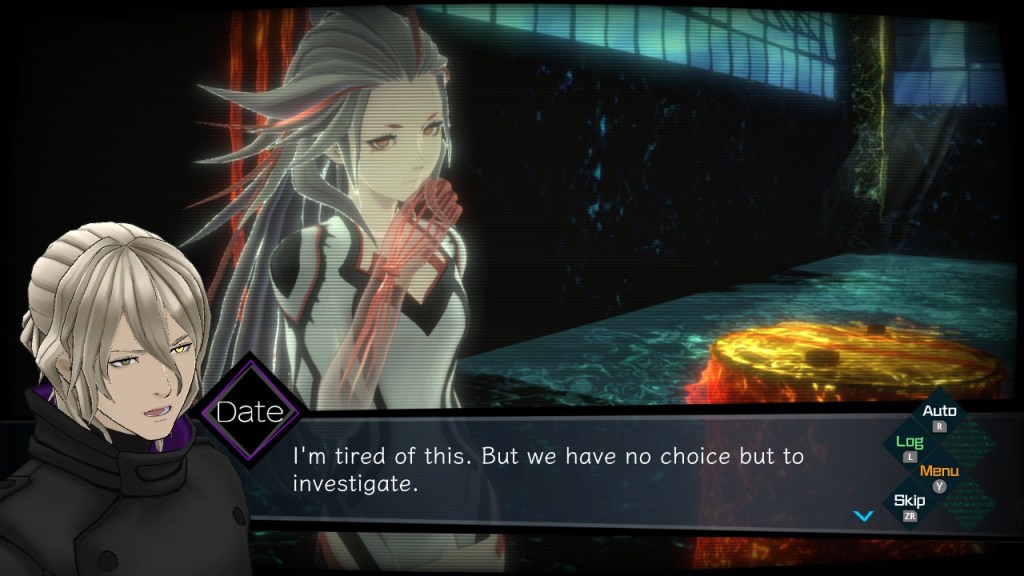
AI’s gameplay is split into two different phases. During investigations, you comb crime scenes for evidence and talk to witnesses and suspects. These sequences are mostly linear, and require little deduction: evidence is easy to find, and talking to suspects just means clicking through dialogue options until there are none left. Occasionally the game asks you to interrogate a suspect by presenting them with evidence to contradict their claims, but the evidence required for these sequences are clear in their use, and these scenes barely qualify as puzzles.
But the game’s titular “Somnium” sections are different. As a member of the “Advanced Brain Investigation Squad,” Kaname Date uses a “Psync Machine” to enter the subconscious dream states of witnesses and suspects who either can’t remember key information or are intentionally withholding it. These somnium spaces function like escape rooms, complete with locked doors barring Date’s progress and puzzles that unlock said doors. But what distinguishes them from typical escape rooms is their surreal, dreamlike nature. For instance, a witness to the game’s initial crime at the amusement park has a somnium that depicts the scene quite differently: in her somnium, the merry-go-round spins at mach speeds, and is also covered by a giant birdcage. Further, the rain clouds now generate constant lightning that electrifies the cage. To solve this somnium, you have to redirect the lightning, remove the birdcage, and stop the ride’s hurricane rotation.
That same surreality extends to the puzzles and their solutions. To redirect the lightning, you have to extend a nearby speaker pole to an impossible height so that it becomes a lightning rod. But the game doesn’t tell you that the pole can extend like that: the only way to know is trial and error, to engage with all of the somnium’s parts and test their non-logical possibilities. But the game also imposes a time limit on these scenes, and failing to solve the somnium in time forces a reset of your progress. This means that, while the puzzles demand trial and error, they actively punish you for errors you could not have foreseen because the dream is non-logical, which forces you to redo your work. It’s maddening, and a huge waste of the player’s time.
That trial-and-error logic is also reflected in the game’s story structure: some of the Somniums create the opportunity for branches in the overall narrative, which shifts the direction of Date’s investigation. These story branches create significant changes: one branch has Date trailing a killer with an escalating body count, while another focuses Date’s efforts toward acting as bodyguard for a single witness. But you do not choose these branches through informed decisions: in the merry-go-round Somnium, the branching decision hinges on whether you choose to engage with a puzzle on the left or a puzzle on the right. And this would all be fine, except that most of these narrative paths lead to unsatisfying story endings with only partial answers and little closure. Only one path leads to a full resolution to the mystery, and I stumbled on that path early on; again, no deduction, I just happened to make choices that would lead me there. But then the path “locked” itself: I couldn’t advance further until I went down the other paths anyway, until I had seen every other story permutation the game had to offer.
But a story’s not just about the conclusion: the journey counts for something too, right? Unfortunately, the main commonality among these story threads is Date himself, and he’s just not an enjoyable protagonist to spend time with. He’s immature, he’s obnoxious, but worst of all, he’s just too credulous and incurious to be a believable detective. During one interrogation he catches a suspect texting an accomplice under the table; why was she allowed to keep her phone? He then agrees to give her a ride to a location of her choosing which, surprise, is a trap. Meanwhile, his colleagues offhandedly mention that they are drugging him, and he asks no follow-up questions. He makes very few deductions, and most of the mystery is advanced when either his AI assistant draws connections for him or when his associates decide that, actually, maybe they should divulge the details of that case from six years ago. The story’s progression hinges on similar info-dumps, usually delivered when other characters just finally feel like it rather than anything Date does to prompt them. It was after one of these expositions that I most enjoyed the game, because I turned it off and wrote down my theory for what the mystery’s resolution would actually be. But then I still had to follow Date’s journey for hours longer as he followed pointless leads and waited for more information to be explained to him.
The central mystery of AI: The Somnium Files is twisty and intriguing, reflective of the strangeness and audacity that I loved in 999; unfortunately, that mystery feels like it’s explored in ways that undermine its every strength. I had one takeaway as I left this game: if your boss ever tells you they’re just not going to divulge information you absolutely need to know, you’re better off quitting.

