
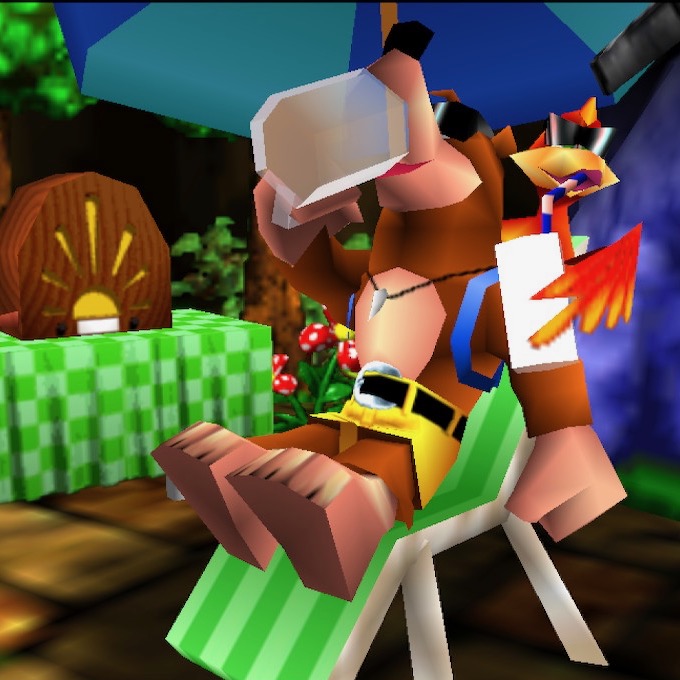
Developed by Rare Limited.
Kazooie is a large red bird with long legs, expansive wings, and a cutting tongue. She spends her days curled up in a bear’s backpack, which is odd for a number of obvious reasons, as well as one very specific one. Banjo-Kazooie is a collect-a-thon platformer game, where the titular bear and bird duo must collect music notes, puzzle pieces (“jiggies”), red feathers, gold feathers, silver skulls, bouncing eggs, caterpillars, honeycombs, and more. Where are you going to keep all of these items, Kazooie? In your backpack? Banjo-Kazooie is an odd bird, more than comfortable with absurdity, but also more sensible and logical than it lets on.
I came into Banjo-Kazooie with high expectations (it’s generally revered), and immediately lowered them. Banjo the bear controls oddly, with big lumbering movement and punches that swing awkwardly at each side. The camera is stiff, and while part of this is attributable to the original console’s limited control options, it still pivots in too-wide chunks, and it’s difficult to line up for jumps which, hey, happen often in platformers! Not to mention the level design often feels unaccommodating to a third person perspective, with lots of corners, tunnels, caves, and enclosures where the camera either jerks back and forth between the least convenient viewpoints possible or gets pinned down like a squirrel beneath a dog’s paw. Worst of all are the swim controls, where you can’t even direct the camera as you dive and manuever more freely in the third dimension. In moments where you need more awareness of your surroundings, you frequently have less.

But here’s the thing: you adjust. You learn Banjo’s momentum, and the way he hits. You learn Kazooie’s, too: she can punch her legs out of Banjo’s backpack and carry him on her back, his head bobbing vacantly to the rhythm of her long strides. The swim movement becomes workable if not enjoyable, with its unruly camera only drowning you sometimes. And out of the water, it becomes easier to make peace with that camera. You learn to not always run with it as it swings, and instead you pause, line it up, consider, and then act. And you learn it’s most important function: by pressing up on the camera control, you can bring it into first person perspective and scan the environment. This is how you look, and understand.
This understanding is the main differentiator between Banjo-Kazooie and the other famous, Nintendo 64-era 3D platformer, Super Mario 64. Both games feature protagonists trying to rescue damsels from villains: here, it’s Banjo’s sister Tootie captured by Gruntilda the witch. In both games, the protagonist navigates a hub world (here, Gruntilda’s tower) to find gates to pocket dimensions where they go on adventures. And both hub worlds seal themselves off with doors and numbers: where Mario collects power stars to explore the castle, Banjo and Kazooie collect jiggies and music notes to ascend the tower.
But beyond that, their focus is quite different. To finish Mario 64, you have to collect only seventy of the game’s one hundred twenty power stars. This leaves you free to explore where you wish and tackle the challenges that appeal to you. The result is a playful game that focuses on freedom and the joy of movement. But Banjo-Kazooie is much more strict than its first-party sibling. To face Gruntilda at the top of her tower, you need to collect ninety-six of the game’s one hundred jiggies, not to mention most of its nine hundred music notes. Banjo-Kazooie sets you a task and doesn’t yield in its requirements. It sits you down and says: you’re going to comb this tower from top to bottom, and you’re going to like it.
It’s demanding. It’s tough. And I loved it.
When you materialize in the first world, “Mumbo’s Mountain,” you have nothing. Ahead of you is a rope bridge. To your right is a steep slope dotted with music notes. Also to your right is a little pink figure with a pointed nose, pointed ears, and wide eyes. You don’t know what his deal is.
So you do what you always do in 3D platformers: you run, jump, and explore. You collect the notes bobbing in the air. You occasionally find a jiggy, whether under a stone or by solving a puzzle. And eventually, you leave that world, either by choice or by death, and you see if you have enough jiggies and notes to advance. Early on, you do. The initial barriers in the game are low, just a few notes or jiggies required to unlock a door or complete a world painting. You go to the next world, “Treasure Trove Cove,” and “Clanker’s Cavern” after that. And then, the asking prices on the doors get a little higher. To advance further often means to return to old worlds and keep searching.
If you revisit “Mumbo’s Mountain” and look at the slope to your right, you see all of the music notes you’ve already collected. If you want to gain more notes to open more tower doors, you need a new “high score.” You need to find music notes you haven’t already grabbed, as well as the ones you already did. The first time this happened to me, my jaw dropped. Isn’t this incredibly player-hostile? Isn’t this busy work?
Yes, it can certainly feel that way. But also, no: when you get down to it, it’s something else entirely.
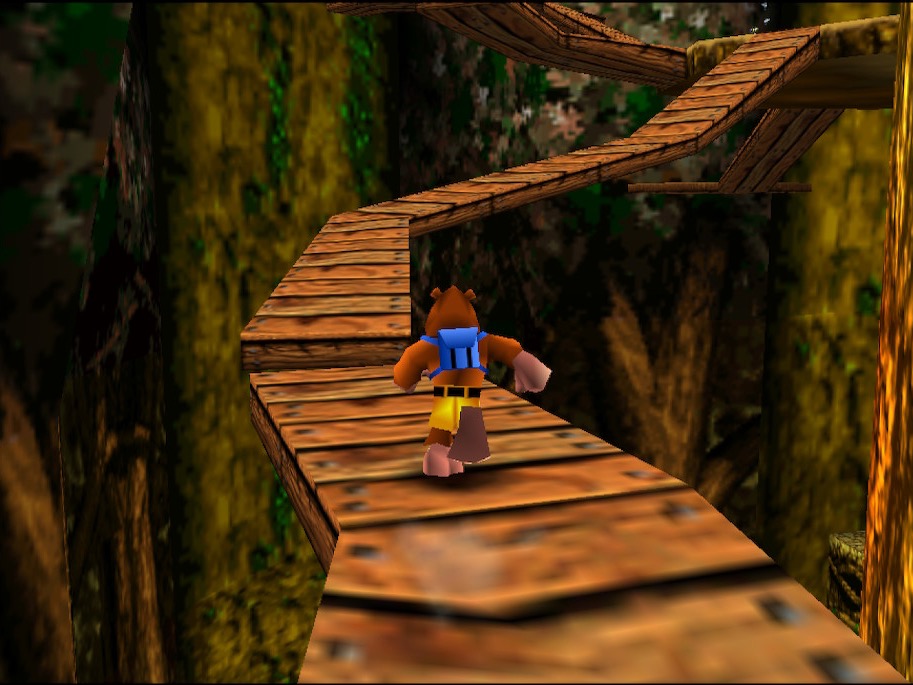
For all the absurdity of Banjo-Kazooie, for its bear and bird and its cartoon silliness, it has an undeniable logic to it. When you start each world, you have to explore, feel out the environment, fight its monsters and talk to its inhabitants. But as you explore, you start to learn its rules and connections. Jiggies aren’t scattered randomly, but evenly distributed: finding one is a clue to where the others may be, and encourages further exploration. And rules apply across worlds: when I solved one puzzle by placing an egg in a vase, it occurred to me that I could do something similar in worlds I had passed by. The point of the collectables isn’t the collection itself, but to drive greater understanding of the spaces you’re exploring. Once you understand how each level is structured and why, collecting notes and jiggies becomes a matter of “figuring out” rather than rote pixel hunting. The collectables aren’t there for the sake of collection, but to drive that sense of understanding.
Yes, the controls take some getting used to. Yes, the camera could be better. Yes, there are platforms and jumps that feel difficult to the point of unfairness. But unlike Mario 64, the movement isn’t the point. The branches of “Click Clock Wood” aren’t always kind to navigate, nor is the rooftop of “Mad Monster Mansion.” But those branches feel like branches, that rooftop makes sense as a rooftop. These are real places first, and platforming courses second. And the former is more meaningful to explore than the latter. I finished the game a few weeks ago, and I still have a vivid grasp of each world, because understanding it, not surmounting it, was the challenge the game set before me.
In Banjo-Kazooie, the whole world is a puzzle, and every piece fits into place. I didn’t see that when I began: the jiggies were the clue.

