
Ember is a squat figure in a blue cloak decorated with white spots. Their hood shadows their face, with only two pinpricks of light to indicate eyes looking outward. In the game’s first scene, Ember awakens in a stone room; nearby is a satchel draped around a skeleton with Ember’s same proportions. This traveler is lost, but there are others that can be saved. Ember takes the satchel, unseals the chamber door, and heads out into the wilderness. I don’t know anything about the skeleton. I also don’t know anything about Ember.
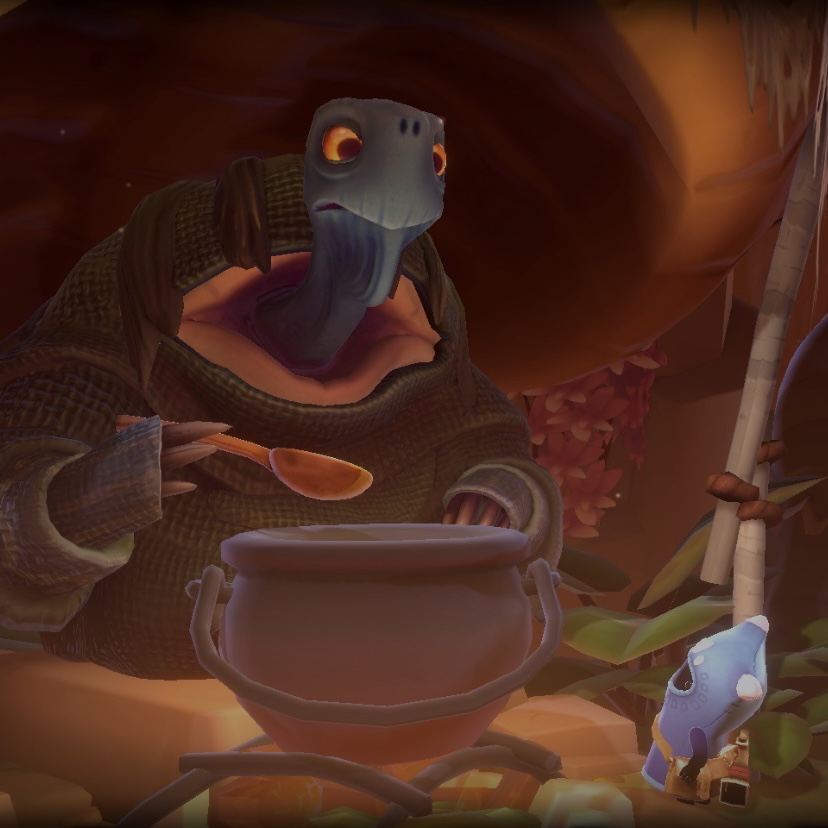
The Last Campfire is a puzzle-adventure game from Hello Games, designed first for Apple Arcade and later ported to other platforms. It follows in the tradition of puzzle worlds such as the Zelda, Monkey Island, and LostWinds, even sharing a development team with the latter. Our protagonist, Ember, is a traveler in a dark forest, one among many wearing similar robes in an assortment of colors and patterns. All of these travelers are lost, though each are dealing with it differently. Ember is active, navigating the forest and solving puzzles to clear the way forward. Some travelers are taking a moment to pause and reflect on their predicament. But most travelers have lost hope and stopped moving at all, petrifying into statues that dot the landscape. A campfire spirit informs Ember that this group of stone figures, the Forlorn, are needed to light the way forward; to revive them, their sense of hope needs to be rekindled.
These Forlorn reached far-flung nooks and alcoves of The Last Campfire’s world before ceasing movement, so Ember’s journey will take them across the land’s wide reaches before Ember can move to their actual destination. Luckily, these spaces are a quiet joy to explore. The environments are all subdued and mysterious, ranging from forests of shadowing canopies and thorny bramble to marshes with foggy heat and crumbling ruins. Absent from these locations are any form of mortal threat; the real consequences lie in the game’s many puzzles, and the likelihood of getting stumped on how to move forward. The world’s puzzles tend to be sprawling; you may need to speak to geographically separate NPCs for important items, or draw connections between a switch here and a sealed door on the other side of a wall. Still, The Last Campfire is kind even when stumping the player: there’s a generous hint system for those who want aid, and an exploration mode for players who want to bypass puzzles and focus on unimpeded navigation of the world.
When Ember does reach a Forlorn, usually after picking their way through a tangle of walkways or conveying the right key to the right lock, they reach out to touch their stone sibling. This enables a Dark Crystal-like meeting of the minds: upon contact, Ember can hear the Forlorn’s thoughts, and experience their problem as a puzzle metaphor. Each of these puzzles are navigational in nature: align the correct pieces, move in the right sequence, and you’ll reach a blue flame of hope that allows the Forlorn to dust themselves off and resume movement. These internal puzzles are more concise than their sprawling overworld counterparts, as is their accompanying narration. A Forlorn tells us of their status-seeking efforts as Ember moves blocks to ascend a temple. Another proudly asserts their independence and denies community as Ember raises bridges to connect solitary islands. Wisely, the game never suggests that Ember solving these puzzles is equivalent to solving these strangers’ problems, and no Forlorn jumps up at the puzzle’s conclusion to declare their issues over and done with. Instead, they express a resolve to keep moving forward. In this way, solving the Forlorn’s puzzles is equivalent to understanding another’s problems, to being a listening ear rather than a hero who carries strangers through the hardships of their lives.
Many of the Forlorn puzzles are elegant in their minimalism: I’m never confused about how a puzzle relates to a Forlorn’s dilemma, or what the puzzle is asking of me as a player. However, I think these puzzles and stories would have benefited from more clutter, more detail. For instance, one puzzle asked me to roll a cube through a maze of burning fires, except one side of the cube was covered in a metal grate that shot air wherever it pointed; I had to move the cube carefully to avoid snuffing any of the fires, at the risk of being made to start over. As I rolled the cube, the Forlorn whispered to me that they’re both concerned over being outshone and concerned about hurting others. In order to get through life, they felt they had to be careful, to always tilt aside from others.
I get it: the wind-cube is the Forlorn, and the fires are the others in the Forlorn’s life. The puzzle is a metaphor, and the metaphor is apt. But there’s a difference between understanding a problem and connecting with the person experiencing that problem. Who was this Forlorn afraid of hurting? In what ways were they being outshone? They share their problems in a way that’s shorn of details, easy to interpret. But the work of listening often means sitting with another as they untangle the messy details of their own lives, as they separate the factors causing their issues with the other moments and details that are merely colored by that hurt. It’s a human element of connection that’s missing in these stories, sacrificed so one person’s problem can be generalized into everyone’s lesson. These Forlorn lack individuality, real history and the gritty texture of real problems tangled up in the lives of others. And so, I solved many puzzles, enjoyed most of them, and cared little for the Forlorn I was ostensibly connecting with.
There were some Forlorn who stood out to me. These were the ones who declined my involvement, who gave me no puzzles and shooed me away. They needed more time with their pain, they weren’t ready to talk. I get that, and I feel that; I’ve felt it often. I walked away from them with a sense of loss. We didn’t make a connection, and I instead felt the ache of its absence. Their path was separate from mine; we’re both wandering. We’re not yet lost.
Played on Apple Arcade for review. Game completed in roughly six hours.

