



Transcript
This is a black and white comic review of the video game Dandara.
Page 1
Review: Dandara
Developer: Long Hat House
Reviewed by Dan McAlister
Panel 1: A woman, Dandara, knees hugged to chest, floats in a black void. She has an athletic build, dark skin, a black afro, simple clothes, bare feet, and a long, glowing scarf that floats around her.
Narration: Dandara awakens into nothingness. A figure in a void, a mark on a blank page. However, she is not from nothing, and this game pulls from multiple traditions.
Panel 2: Dandara holds a glowing orb.
Narration: The game structure is pure Metroidvania: Dandara must navigate a maze-like world, acquiring powers that unlock new paths.
Panel 3: A dark figure with a turban looks away, into the distance.
Narration: It also pulls from history, as the title character is named for a real-world Afro-Brazilian revolutionary.
Panel 4: A figure wearing an Anubis-like dog mask stand with a spear at the ready. Mysterious tendrils tipped with large eyeballs emerge from the right.
Narration: Finally, the game is filtered through the lens of surrealist fantasy. This is a broken, twisted world that is straightforward in neither mechanics nor story.
Page 2
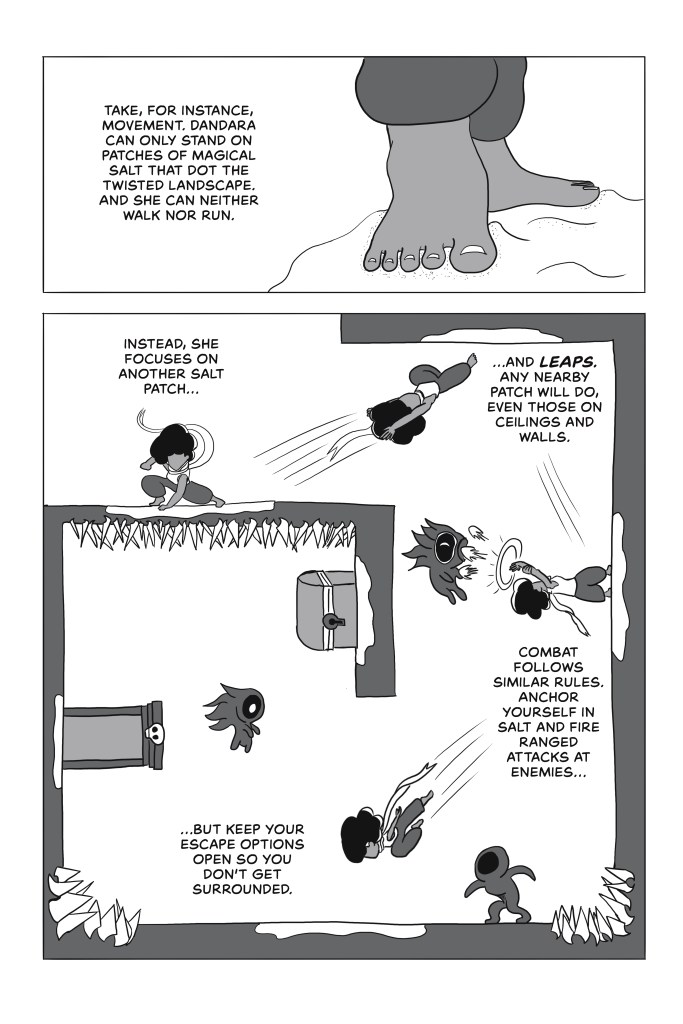
Panel 1: A shot of Dandara’s feet atop a pile of white salt.
Narration: Take, for instance, movement. Dandara can only stand on patches of magical salt that dot the twisted landscape. And she can neither walk nor run.
Panel 2: A large, twisted environment full of enemies, spikes, a door, and a chest. Dandara leaps from surface to surface, standing on floors, walls, and ceilings, navigating the space while fighting enemies with laser blasts fired from her hand.
Narration: Instead, she focuses on another salt patch and leaps. Any nearby patch will do, even those on ceilings and walls. Combat follows similar rules. Anchor yourself in salt and fire ranged attacks at enemies, but keep your escape options open so you don’t get surrounded.
Page 3
Panel 1: Dandara stands on a floating, salt-covered platform. Other salt-covered platforms float nearby at odd angles.
Narration: It’s an odd, novel movement scheme, and the world is suitably twisted to challenge it. This is the game’s greatest strength: it’s not afraid to drop you into the strange unknown, or let you wander into areas you’re not ready for.
Panel 2: Metroid’s Samus Aran walks near a sign pointing her in a specific direction.
Narration: Modern genre staples, like Metroid Dread, don’t demand real exploration. They have maze-like environments, but often position you in front of paths that are both obvious and correct. Exploring the maze is only minimally necessary.
Panel 3: Dandara sits on the floor of a corridor, consulting a map.
Narration: But my favorite moments in Dandara happened when I would conquer a challenge and think “now what?” I would consult the map, get lost for a while, and deduce the answer for myself.
Panel 4: Dandara stands on the ceiling of a twisted room. The floors, walls, and ceilings are covered in salt patches and enemies. There are two doors and one chest.
Narration: But while I appreciated the overworld design, the game’s individual rooms and challenges rarely impressed me. They’re functional, and occasionally clever in how they challenge Dandara’s unique movement but they rarely felt inspired, and few individual sections were memorable.
Page 4
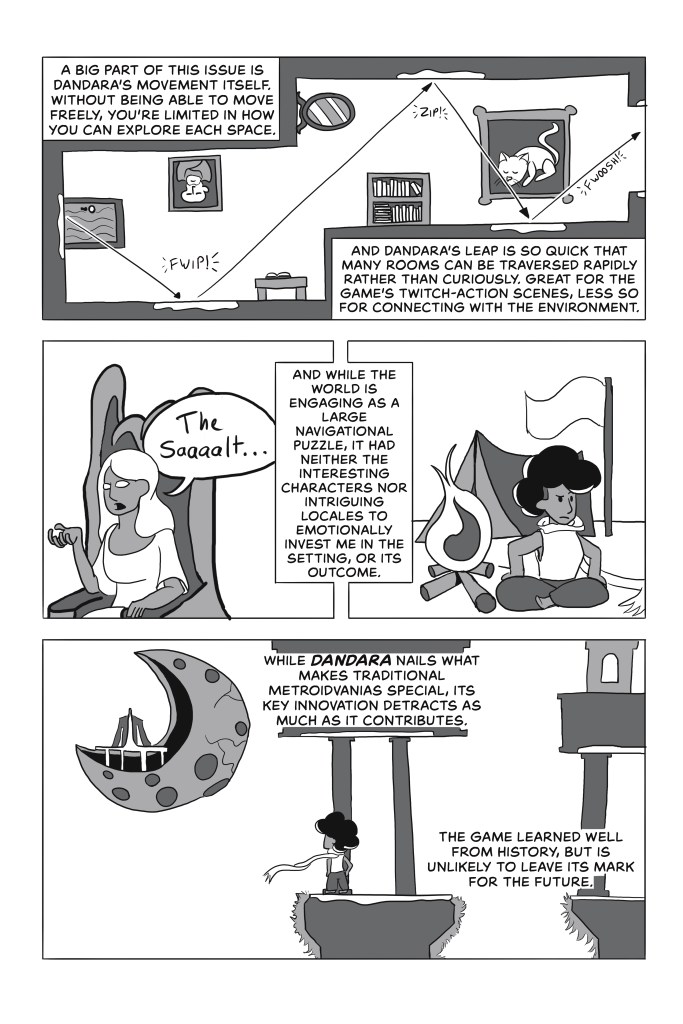
Panel 1: Another twisted room decorated with paintings, a bookshelf, a table, and a mirror. A line representing Dandara’s motion starts at a door, bounces on each of the salt patches, and continues down a corridor and out the panel. This bouncing line is paired with the sound effects “Fwip!” “Zip!” “Fwoosh!”
Narration: A big part of this issue is Dandara’s movement itself. without being able to move freely, you’re limited in how you can explore each space. And Dandara’s leap is so quick that many rooms can be traversed rapidly rather than curiously. Great for the game’s twitch-action scenes, less so for connecting with the environment.
Panel 2: A slender woman with dark skin, pale eyes, pale hear, and a white dress sits on a misshapen throne. She says “The saaaaaalt.”
Narration: And while the world is engaging as a large navigational puzzle, it had neither the interesting characters nor intriguing locales to emotionally invest me in the setting, or its outcome.
Panel 4: Dandara sits at a campground complete with fire, tent, and flag, looking skeptically off into the distance.
Panel 5: Dandara stands among stone structures held up by pillars. She looks at a crescent moon in the distance. A mysterious structure seems to be built on the crescent’s inner curve.
Narration: While Dandara nails what makes traditional Metroidvanias special, its key innovation detracts as much as it contributes. The game learned well from history, but is unlikely to leave its mark for the future.

