
Developed by Team Otto for Playdate’s Season 2.
I don’t replay many video games, at least not the narrative ones, the ones with defined beginnings and endings. I also don’t re-read many books, or re-watch many movies or shows; when a good story is over, I’m thankful for the experience and content to move on. But music albums are different, and I would imagine that’s true for most people like me. I often appreciate good albums more on repeat listens than initial ones, and music’s inherent basis in pattern and repetition lends itself more strongly to the repeat experience than other mediums do.
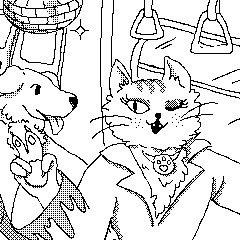
Otto’s Galactic Groove!! is a Playdate rhythm game structured like an album, and it similarly reaps an album’s benefits. You play as Otto, a weird pet that looks like a cross between a small dog and the end of a mop. His owner, Tomie, is an alien musician who struggles with a creative block, so she sends Otto off in a spaceship to search the galaxy for inspiration for her music. Each element of inspiration is on a different planet, with a resident who asks something of Otto in return. A shark asks you to surf with him. A cat on a disco space train asks for help repairing a door. A girl on a vending machine planet asks for help in winning prizes. Inevitably, each request becomes an exercise in collaborative music making.
The rhythm gameplay is simple and effective. Dots and lines appear on the left side of the screen and move to the right. You rotate the Playdate’s crank to move a target up and down to contact the dots and lines when they reach the right side, and you press or hold any button on such a contact to trigger a musical note. It’s not novel gameplay, but it is solid, and the music is as pleasant and varied as the oddball characters you meet.
I enjoyed my playthrough. I enjoyed the silly characters and the nice songs. But I also made an error: in not thinking about the game as an album, I didn’t play it in one sitting, which I think most benefits an album format. I played through some songs on one day, and others on other days. I dropped in and I drifted away. I experienced Otto’s as pleasant, non-sequiter thoughts rather than as one whole.
But then, when I realized that the game was short enough to be album-length, I came back to it and played it again in one session, all the way through. And I got more out of it, not just from the repetition, but from giving the game my sustained attention.
Played separately, the songs are varied, and pleasurable. They mostly inhabit a space of electronica and chiptune, but also include detours into rock and folk, and I enjoyed each of them as individual tracks. But played together, I better appreciated the way this eclectic mix points to how inspiration comes from diverse sources, and that it can happen as exchange and engagement with people from many walks of life.
A standout for me was a planet where you help a fish man get over the “girl-fish” who just left him. His songs are meandering and forlorn: they give off a sense of wandering and searching for meaning in emptiness. This happens without lyrics: he plays a guitar, and your notes supply a sliding synthesizer. I enjoyed his songs on my first playthrough, but it was on my second that I understood them as a dialogue between the two instruments who found each other in the expanse. And critically, missing a beat in Otto’s drops the corresponding sound from the song: to mess up is to steal the synthesizer away from the guitar, and to consign the guitar to solitude. The result is that you really are jamming with these inhabitants, rather than playing a game while they play the song. This is music as contribution and participation rather than as audience, and after each song, it’s shown that Otto has helped the inhabitants in return. Sometimes it’s an emotional aid, like the way you help the fish man process his feelings, and other times it’s material aid, like fixing the space-train’s door after your jam session.
Otto’s Galactic Groove!! is pleasing on the surface, but yields more on repeat engagements. I appreciated its reminder of how art-making benefits from collaboration and exchange; these are things I know, but could stand to be reminded of from time to time. The next time I need that reminder, I’ll know what game to revisit.
Elsewhere, on Our Wonderful Web
Today I recommend reading “In Silksong, spite is my motivation to keep playing” by Ash Parrish at The Verge. She gets at two things that have been on my mind: how “fun” is not strictly necessary for appreciating a game, and how playing alongside others can enrich an experience.
 Butternut Ape