
Developed by Nintendo EPD.
The water here is different. It chops in rough waves around Wario Shipyard, but it’s calmer at Koopa Troopa Beach where it laps at the shore. If you drop something in this water, it ripples. It reacts.
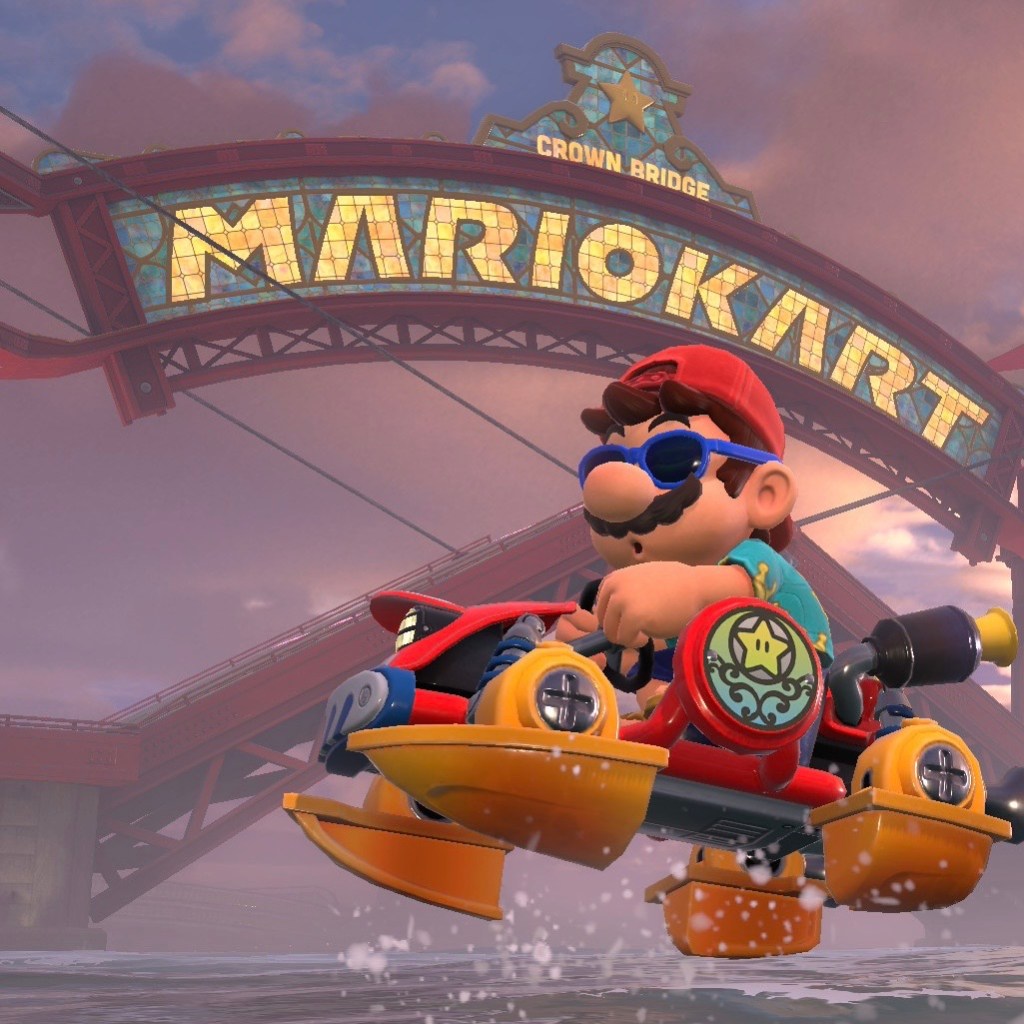
Mario Kart World is the best the series has ever been, but not for the reasons you may think. It’s not because, for the first time, the races take place across a contiguous continent rather than on isolated tracks, thought that is part of it. And much as I like them, it’s not because of more advanced water simulations, though they too are a factor. Mario Kart World differentiates itself from its predecessors in the way it puts you in a world, which cannot be evoked with land alone. You need others with you.
When starting my first four-race cup, things felt familiar, but more crowded. The field has expanded from twelve to twenty-four competitors per race, and the chaos has seen a commensurate expansion as well. With twice the racers and item boxes that respawn almost instantly after they’ve been collected, the experience feels more assaultive than ever. More shells, more banana peels, and more detonations rock the throng of racers that collect at the pack’s middle. It’s a Mario Kart rite of passage to fall short of the finish line because you got struck by a last-minute explosion. Now you can be struck by about five at once. How can a more capricious game be better?
While World presents a more crowded environment in which to take hits, it also makes those hits more forgiving. Being struck by a shell now results in a tumble that lands you back on your wheels with only a small penalty to momentum. The real danger is in getting hit by multiple, creating a chain of disruptions that halt your motion and scatter the coins you collect that increase your overall speed. A single strike is a setback, but multiple are a tragedy. And so, the most important factor in racing is not knowledge of the tracks, but awareness of the crowd.
If you’re near the crowd, you’re likely to get hit. Some karts, the ones with faster acceleration, are more suited to this kind of scrapping, but other karts with lower acceleration and higher top-speeds may benefit from avoiding risk and skirting the crowd’s edges. But while awareness of the crowd is more important than racing to the course, the crowd’s motions are dictated by the courses, so they can’t be ignored. Wide paths allow for the dispersion of both the crowd and the risk, but then paths narrow and split, forcing racers into tighter channels and more conflict. These moments made me think of the crowd not as a collection of individuals, but as a flow of water, pressurized when constricted. It reaches it’s highest level of churn in the game’s traditional circuits, but it’s not absent from the game’s point-to-point races that connect those circuits. Despite their wider, more even paths, they’re filled with opportunities to guide the race’s current. The crowd will gravitate towards boost jumps and double item boxes: will you follow it, or forsake those benefits to take a safer route?
But the most exciting way the game shapes its current is in its newest items. The Coin Shell punches through the center of the track, knocking the crowd apart at its thickest and trailing speed-boosting coins behind it that draw other racers into its wake. The Question Block grants coins to the racer that uses it but also drops them for others to pick up, drawing racers closer together. And there’s reward to the risk of staying in the thick of things, as successfully drafting behind an opponent yields the game’s most potent boost. If you can avoid the shells and the boomerangs and the bombs, that is.
The game is filled with these elements that stir the pot and churn the water. The point-to-point races that appear to take place on the most stable land are the most prone to unexpected disruption, whether that’s the highway traffic around Crown City or the irregular migrations of giraffes near the Faraway Oasis. The waves around Wario’s Shipwreck are not cosmetic, they plunge deep and rise high, forming unpredictable ramps as your kart-boat sails across them. And when a blue shell lands in these waters, it pounds down on not only its victim but the water itself, sending out concentric waves that can buffet or propel you, depending on how you react.
There will always be elements of luck at play in these races, and “better driving” on the course will not guarantee victory or even a good placement as it did in some of the less item-heavy entries like Mario Kart Super Circuit. Instead, it’s a game that demands awareness of everything: the course and the crowd, the opportunities and the obstacles. You are not contending with any one of these elements, but all of them. You are racing against the world.
Elsewhere, on Our Wonderful Web
Today I recommend reading All 54 lost clickwheel iPod games have now been preserved for posterity by Kyle Orland at Ars Technica. I had no idea there were games for those older iPods, let alone Sonic the Hedgehog.
 Butternut Ape