
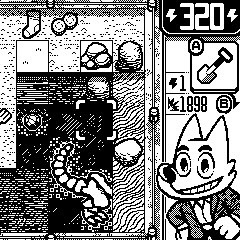
Developed by Dom2D & Fáyer for Playdate’s Season 2.
Why do dogs dig up bones? For Lucas Castillo, it’s a job. He’s a cartoon dog with a gray jacket, black pants, and the title of “Excavation Director,” and he and his team of paleontologists have work to do. But this is still a game, right? Are we doing this for work, or for play?
Dig Dig Dino! is a simple paleontology puzzle game about digging, dinosaurs, and what lies hidden in the earth. Gameplay is straightforward: you start with a shovel in a grassy field, and you dig holes. You scoop up grass, sod, dirt, and clay, peeling the ground apart layer by layer looking dinosaur bones. Sometimes you find them, like small triangular skulls or large femurs. Other times you find old soda bottles, rusted cans, socks, forks, or even diamonds. The earth hides much, it turns out.
Digging expends energy, represented by a number in the screen’s corner, and the excavation ends when your energy runs out. At that point, your discoveries are tallied and analyzed. New artifacts and bones are retained for your team’s collection, while garbage and valuables alike are sold off. The funds from these sales can then be used to upgrade your equipment. Investments in your shovel can make it punch through layers in fewer strikes, while investing in your energy reserves can allow you to take more actions before leaving a site. You can also purchase new tools: a drill can demolish rocks that otherwise impede your progress, while a radar can ping secrets hiding in the next layer of soil. After upgrading, you return to the dig site, where you start again from a clear patch of grass and dirt. You’ve clocked in for another shift.
There is a simple back and forth of action and investment in Dig Dig Dino, and it’s all done at a relaxed pace. There is no time limit, and you can return to any site as many times as you want. Skillful exploration can expedite the process, but only so much, because each site, on each visit, has a limited number of bones. Early on, they will all be new. Later, as you try to complete your collection, they will mostly be repeats, which can be sold off along with your trash and treasure.
Here’s a question worth asking of any game: why am I doing this? And like most games, there are intrinsic and extrinsic answers to this question. The digging is pleasant, and creates puzzles in miniature when you need to excavate a bony forearm from beneath a buried stone. The characters make for focused but affable co-workers, offering more smiles than chit-chat while still enjoyable to engage with. But while there’s a pleasing workplace familiarity to the gameplay and characters, the story is a sharp turn into the unexpected. As you uncover artifacts and skeletons, you learn not just about the varying dinosaur species, but about a strange threat they faced and what their life was like under that threat. It’s a bizarre swing for a game about a cartoon dog with a shovel, and also the game’s strongest element, contrasting a sense of darkness and intrigue against the game’s otherwise cheery visuals. This weaving-in of the unexpected makes the world feel bigger and more unruly than what we would expect from a life spent clocking in and out.
But as much as I liked that weird story, I didn’t finish it, at least not in a sense where I rolled credits or completed my collection. Because you advance the story by making new discoveries, the story’s pace is tied to the rate at which you collect new bones and relics. But as you keep digging and keep revisiting the same sites, there are fewer new bones to find and more repeats, which massively slows the story’s progression: you get paid when the repeats are sold, but that’s not the compensation that I’m interested in.
I enjoyed the digging and discovery, but when discovery left my enjoyment of the digging was not enough to continue. That’s OK, though: it’s in the nature of searching to not find everything, to leave bits behind. There are bones left under the soil still waiting to be discovered, but I’m happy to let them rest in darkness. I found enough of what I came for.
 Butternut Ape