
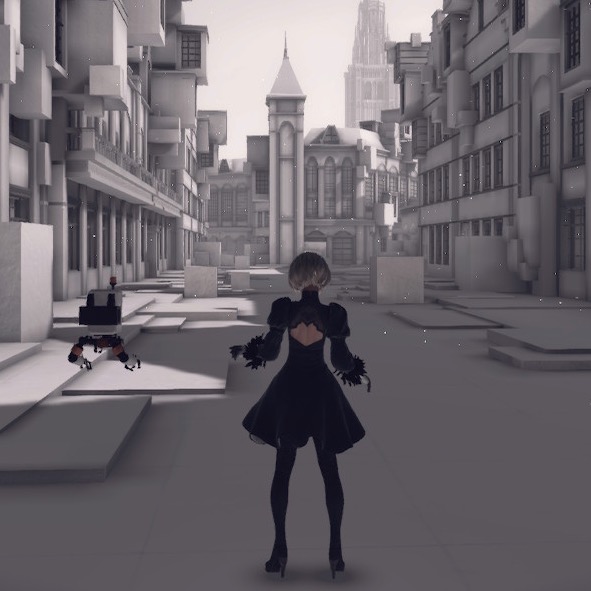
Developed by PlatinumGames.
Android soldier 2B wears a pair of swords on her back and a black blindfold across her eyes. The blindfold doesn’t seem to impair her fighting or her awareness; sometimes she even takes it off, for reasons as unstated as why she wears it in the first place. Obscured vision here is a mystery that intrigued me, but what would the game ask in exchange for those answers?
Nier: Automata is a hack-and-slash action RPG that takes place in the distant future. Aliens have invaded, and their clanking, ominous machine forces have overrun the Earth. The last remaining humans retreated to the moon and now send android soldiers, made in their image, to fight the machines in their stead. You play as 2B who, with her partner 9S, carries out missions to advance the human war effort.
When I say the androids are made in the image of their human creators, there’s likely some embellishment happening on the creators’ behalf. The android soldiers mostly look like skinny dolls in frilly dresses, whose skirts are cut in the front so that they don’t cover much at all. And if it’s impractical to fight blindfolded, what about fighting in high heels? 2B, at least, shows no hindrance. She pounds across the battlefield, stylish footwear clacking against concrete and then swishing through tall grass. She moves swiftly and strikes hard, her sword slicing clean through the rusty machine enemies. If her absurd outfit paints an idealized beauty, her battle performance indicates obvious, super-human physicality and precision.
What’s most interesting about 2B’s combat abilities is the hybrid nature that weaves together elements of multiple genres. At their core is a simplistic blend of button-mash strikes and a Bayonetta-style dodge, which is fitting, as developer PlatinumGames worked on both titles. Additionally, 2B’s floating drone can fire laser streams reminiscent of spaceship shooter games, and Nier sometimes pivots the camera to an overhead angle to make the comparison explicit. On top of all this is an RPG levelling system that lets you tweak weapons and abilities. It’s all overwhelming in the game’s opening sections, feels great when it all clicks together, but unfortunately starts to drag about ten hours in. Because for all of Nier: Automata‘s seeming combat complexity, the battles are easily cheesed. The dodge maneuver has a forgivingly wide invincibility window and can be spammed, making you almost invincible until an enemy pauses its attacks and gamely allows for retaliation. Further, you can keep shooting while you dodge, meaning you can whittle away at most enemies without ever exposing yourself to danger. And while the boss battles introduce some appreciated complexity, the minions and mobs soon become tedious cannon fodder and there’s way too many of them. The overhead, ‘shmup-style battles could have been a welcome injection of variety, but they’re mostly trivial and overly long. At the very least, they compare unfavorably to a dedicated shooter title.
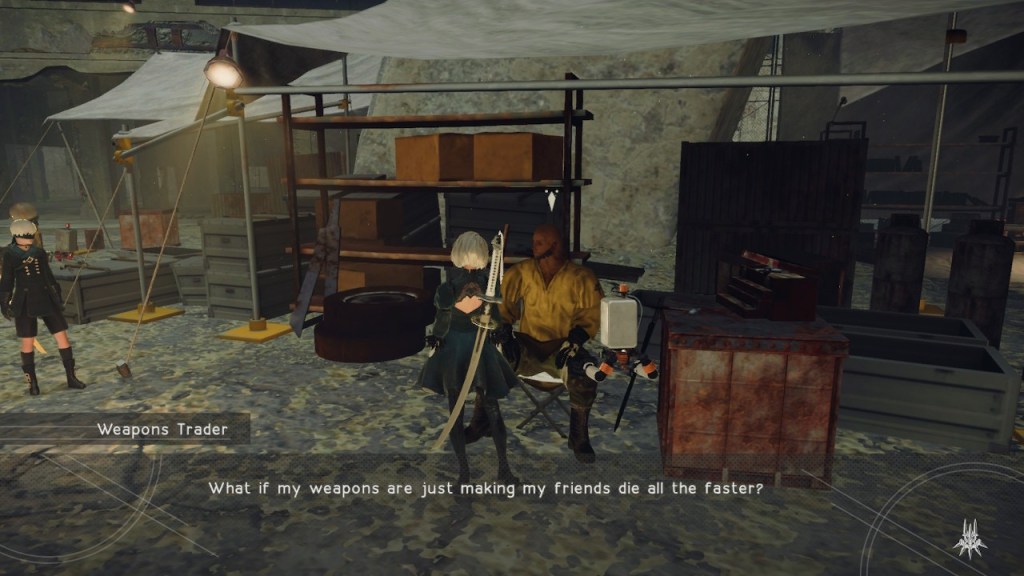
As disappointing as the combat becomes, there’s actually a lot here that I like. The game is full of stirring contrasts: idealizations against reality, sleekness against rust, greenery punching up through old concrete, a black-and-white space station where missions are planned against a world painted in a wash of grays and hues. It’s a world that begs curiosity and investigation, while 2B’s blindfold and the game’s sections of forced perspective draw into question how limited our perspectives often are. My favorite moment came after 9S and I cut down a squad of enemies who fought while begging for their lives. This prompted 9S to speculate: machines don’t think, don’t make meaning, so what’s prompting them to string together those words in that order? It’s a beautiful moment of someone bending over backwards to avoid seeing what’s right in front of them, but it’s also challenging: in what ways are we blindfolded to the truth every day?
Playing the game, I could never shake the feeling that these obvious contradictions belied something else, another story I was missing, a more challenging truth just around the corner. I’ve played games like that, ones that reveal themselves over time, and I’ve loved them. Then, when I beat Automata, I received a confirmation of sorts, an invitation to play the game again from a different perspective, to see different things. I gave that a shot, for a few hours, and then I stopped. It was different, a bit, but mostly the same. An intriguing world, but I was still being asked to do the things that wore on me hours ago. I do believe that there’s something valuable around the corner, but I don’t believe that value will return enough of what I’ve paid. To assume otherwise would be to follow orders at the cost of ignoring what is in front of me.
 Butternut Ape