
Developed by Obsidian Entertainment.
Octav the Firebrand, for all his banditry and infamy, is not shy. He set up camp with his gang in a copse of ruins and overgrown weeds just a short jog away from Paradis, the local settlement they had been terrorizing, in a seeming gesture of confidence. Yes, there’s a bounty on these folks, but who’s going to claim it? He’s a fierce fighter known for his flaming knives and deadly gang. However, his greatest asset exists outside of his awareness, a UI icon that floats above him, emblazoned with the number 2 and a skull. This marker signals his strength, a warning from the game to the player. But my character is marked as well.
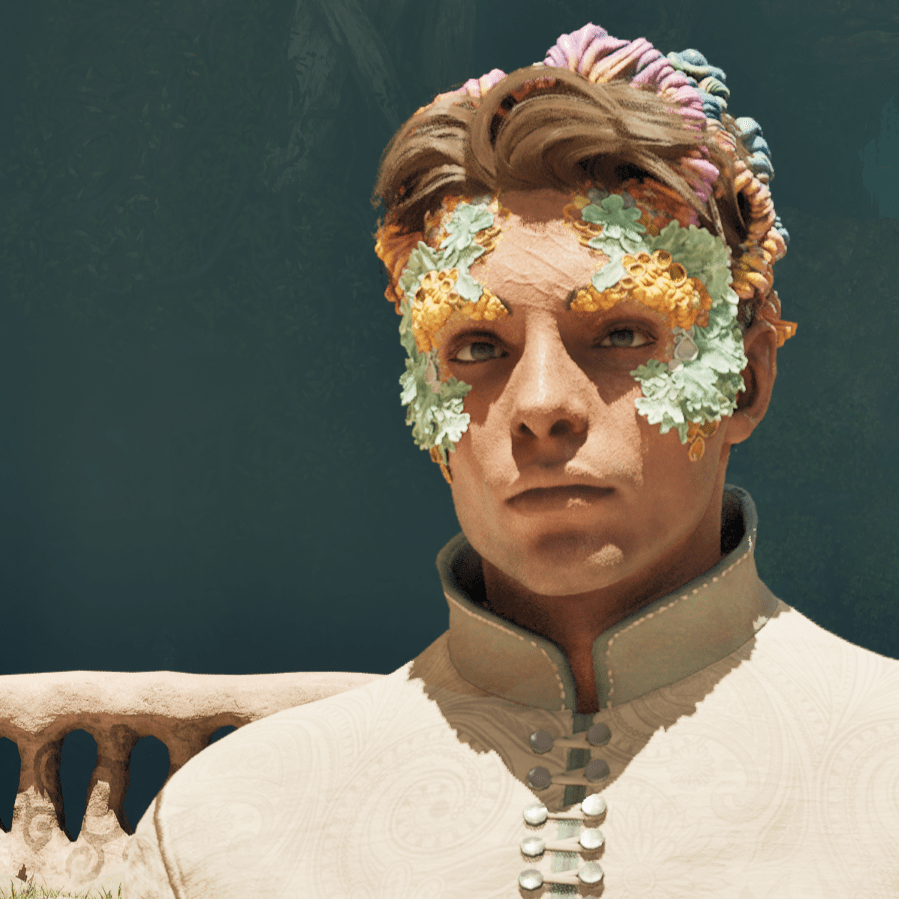
You are a “godlike,” a person blessed at birth with a connection to a god that manifests itself in your physical features. As a player, you can determine what those features are from a variety of floral and fungal protrusions on your head: for me, this took the form of pink, orange, and cyan mushrooms dotting my temples and pushing up through my hair. This kind of marker is diegetic: the inhabitants of this world see these features and know what they mean. The UI icon floating above Octav’s head is non-diegetic: it exists as a convenience of video game logic, outside the awareness of the local populace. Only I, the player, see that marking and read its meaning.
And, in both instances, the people looking at the markings mistook their implications.

Avowed is an action RPG from Obsidian Entertainment. Your godlike is the envoy of the Aedyran empire, sent to the far-off Living Lands to investigate and halt a plague called the Dreamscourge, which has been transforming the Living Lands’ inhabitants into mad zombies. This mission has two complications. First, Aedyr’s relationship with the people of the Living Lands is fraught due to its heavy-handed efforts at diplomacy and its unsubtle attempts at forced colonization. Second, the most prominent marker of those infected with the Dreamscourge is a growth of floral and fungal protrusions across the head and body. The zombies you’ve been sent to investigate look just like you.
The premise is complex. As a fantasy hero, stopping the Dreamscourge would be an indisputable good, but as an envoy of a threatening empire your relations with the locals are often strained. And as a godlike, people expect you to be a wellspring of divine wisdom, but this is a mistake: for your whole life your god has maintained anonymity and distance, forcing you to rely on your own wits, and on the information you can gather to make critical decisions.
Similarly, when I saw the UI markers floating above the heads of the Firebrand and his gang, with their numbers and skulls, I thought I knew what they meant: this enemy is “high tier” and too difficult for you! Go grind, gain experience, upgrade your gear, and come back! Do things in order! How tedious; I chafed at that. I attacked anyway, and died. I attacked again, and then ran. And in running, I discovered something new. I stumbled into a cave occupied by a mad wizard, and fell into another adventure.
What I at first mistook for arbitrary road-blocking was instead something more interesting: a dynamic system of difficulty to play with. The high-tier enemies can be beaten with proper strategy: they do more damage, and resist more of your attacks, but they can sometimes be vulnerable to stealth, or traps, or they can be circumvented altogether. The tier system isn’t a hard block, but instead a challenge, and sometimes, a re-direction. Engaging with them can reveal new options, like how, in trying to avoid them, I discovered something interesting and new. The marker I saw didn’t indicate an impassable barrier: it was just more information with which to make guesses and test hypotheses.
Avowed, despite looking like a naturalistic simulation of a world, makes many smart concessions to “video game logic” and non-diegetic signaling, and emerges better for it. The tier system is a clear signaling of difficulty, giving you options on how and whether to engage. Heavy wooden chests emit a high-pitched, tinkling hum when they’re nearby, leading to impromptu treasure hunts across joyfully twisted dungeons and crumbling buildings. Breakable objects are labeled with another clear UI marker, saving you time from swinging your mace at every box in the game. Accurate simulations have their place, but Avowed uses its unreal, video game-y elements to give you the most pertinent information to inform your decisions in play.

And Avowed is full of tricky choices to make. As a branching narrative game, these most obviously manifest in choices made in dialogue, and what can start as a simple request often unfurls into something much more complex. Over the course of the game, I was asked to weigh human lives against the preservation of a dead civilization’s irreplaceable ruin. I was asked to intervene in the affairs of a dying soldier who was in conflict with his loved ones. I was asked to decide whether or not to save a settlement from destruction when its tyrannical culture made prisoners of its own people. And among all of these, I engaged in much smaller, simpler choices as well. Vengeance, or mercy. Diplomacy, or combat.
Being an action game, negotiations often broke down and resulted in fights. Luckily, the game’s combat is also full of interesting choices. It starts with character customization: you can equip your character with various weapons and armor, and also choose skills for them within an open menu. While there are separate skill trees for fighter, ranger, and wizard abilities, this is a classless system and you can pick options from any tree. I built my character largely as wizard, but invested a few points in the fighter tree to augment my mace and a few more points in the ranger tree to summon a large, spectral bear.
Once in combat, the game again emphasizes informed decisions. Enemies telegraph their attacks through movement and posture, a diegetic signal you learn to read to plan out your own tactics. Throw in a quick-step dodge, and battles often have a boxing-like back-and-forth cadence, requiring both planning and skillful reaction. In my own case, my magic was effective for crowd control, while I used my mace to duck-and-weave among attacks and land heavy, stunning blows.
For all the information Avowed makes available to you, I rarely felt like I could fully coast on autopilot, and the game would check me when I did. I would feel I had an enemy combatant figured out, and then an unseen ally would join the fray. I would agree to help a villager, and find out later, too late, that their goals may not align with my own. For a game with such legible information, Avowed holds many secrets in turn, and it uses surprise to make you question your choices. This is where the game is at its best, when it confronts you with the limitations of the informed decision. There’s always something more to learn, but some things can only be discovered once you commit.
 Butternut Ape