
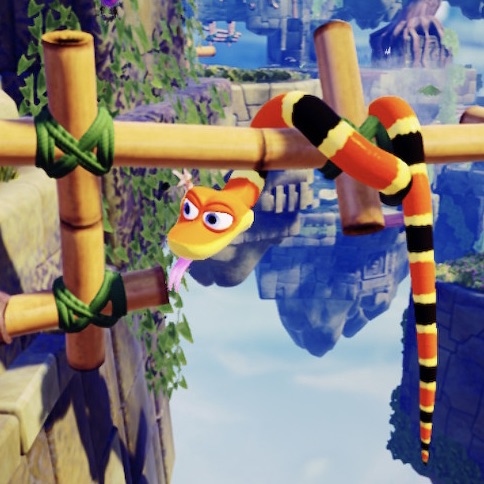
How do you move yourself across a room? I would walk, which for me feels automatic and simple. But walking, as an action, can be broken up into (literal) steps. Move your leg, place your foot, adjust your balance, start to pick up the other leg, and so on. When was the last time you considered your own movement like this? Not as an automatic function, but as a process that you had to be conscious of, that you had to practice and learn? For me, it was toddlerhood. I had a body, and I was new to it.
How do you move yourself across a space in a video game? If you’ve been playing games for a while, this may also feel automatic, even for a game you’ve never played: push right on the D-pad, or tilt the analogue stick. And maybe a button for jumping, or for breaking down obstacles. We occasionally start playing with new technologies that require new interactions, such as touch screens or virtual reality setups, but those games often try to build on existing traditions, and movement quickly feels natural again. Each game gives us a new body to inhabit, but few of them require relearning to walk.
Snake Pass never asked me to walk because it’s protagonist, Noodle, is a snake. Snakes don’t have legs. They don’t have arms, either. And tilting the analogue stick doesn’t move you forward. You have a mountain to climb, but first you need to learn how to move.
At the beginning of Snake Pass, Noodle is napping when a mysterious disaster strikes his home in the jungles of Haven Tor. Alongside your humming bird friend Doodle, you set out to find keystones missing from mystical gateways and ascend the local mountain to find the disaster’s source. Each level takes place in a chunk of the mountain floating among the clouds; fall off and you’ll re-materialize at a glowing checkpoint. Other dangers include lava, spikes, and your own clumsiness in adjusting to your new form.
Like I said before, the analogue stick doesn’t move Noodle like it does other game characters. Instead it moves his head, but only left and right. There’s a separate button for lifting your head up, and another for tilting it down. The “move forward” action is actually assigned to a shoulder trigger, except it’s rather conditional: Noodle can only move forward when he’s already scrunched up in some way. Usually, this means tilting your head left and right to sidewind into a propulsive slither. Other times, it means coiling yourself around a pole, stone, or other object to climb upwards.
Snake Pass is a platformer at its core, but none of these movement controls include the genre’s classic “jump.” Noodle can’t cross his environment as his fellow genre stars would, and his challenges don’t often look like a Mario level anyway. Where a typical platformer would center the namesake “platforms” to jump between, the most common obstacles here involve bamboo poles lashed together to form various structures. These challenges start gently, with bars arranged as small hurdles and fences. By the end of the game, I was wrapping tightly around spinning windmill blades over lava channels. I would clench to each pole (there’s a “clench” button for this), waiting for the precise time to release and reach for the next moving grip-point.
Climbing these structures usually requires lifting your head to clear an initial bar, then circling yourself around it in a grip before stretching for the next available space. Using your whole serpentine form is critical, and requires more awareness of the body than most games ask of you. Your tail, used properly, can anchor you with a grasp onto a safe pole. Or you can droop it over an edge, counter-weighing you as you stretch your head in another direction. But let your tail dangle carelessly, and its weight will pull you off your current lattice and into the sky below. This is all made more tricky by the fact that you don’t control your tail directly; where the head goes, the tail simply follows. At its most complex, Snake Pass demands you consider the consequence of each movement you make. If you swerve your head through here, where will that pull your tail? How will your weight be distributed? Will you be secure, and if not, will you be in a position to twitch yourself into a safer position before you plummet?
This process of learning to navigate yourself over increasingly demanding levels will always benefit from forethought, though trial and error seems unavoidable, especially with some viewpoint challenges. Noodle can contort through all kinds of narrow crevices and twisty bamboo-mazes, but apparently the game’s camera cannot. It was often reluctant to show the angles I think would have been most useful for judging spaces and potential maneuvers. While many of my errors stemmed from failing to fully understand Noodle’s movement, too many falls were the result of a poor view through which to consider my options.
I never felt fully natural moving as Noodle, but the experience was always engaging and thought-provoking. Upon beating each level, an arcade option opens up for snakes who want to revisit old challenges as a speed trial. I’m not that snake. I will never understand this form well enough to fly through the mountain’s obstacles in a way that feels simple or automatic. My journey through Haven Tor was filled with clumsy stumbles and lethal plummets. But each time Noodle re-materialized, I was eager to try again, to be learning movement in a new kind of body.
 Butternut Ape